Set the checkbox state you intend.
Use a desired checked state when the journey requires an outcome, and keep toggle coverage separate.
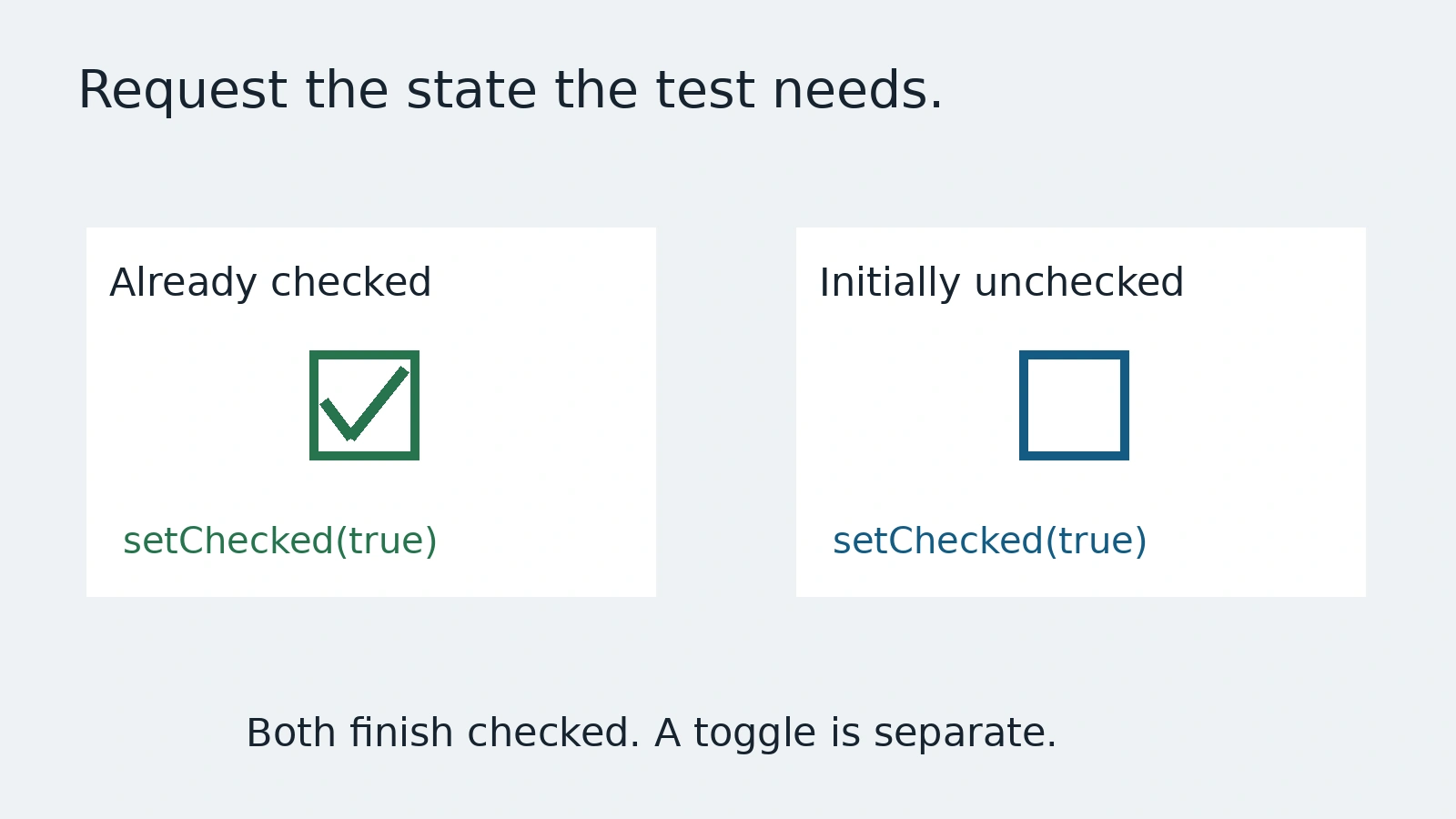
A preference is already enabled when a generated test starts. The test clicks its checkbox to enable it. The click succeeds and disables the preference. This can happen when the author copied a gesture without recording the required starting state. The test should say whether it needs a toggle or a particular final value.
Playwright's Actions guide describes checkbox methods, and the Locator API documents setChecked(). When the matched checkbox already has the requested state, the method returns immediately. Otherwise it performs the action and checks the resulting state. That behavior is useful when the requirement is to leave an approved test preference enabled.
Express the desired state
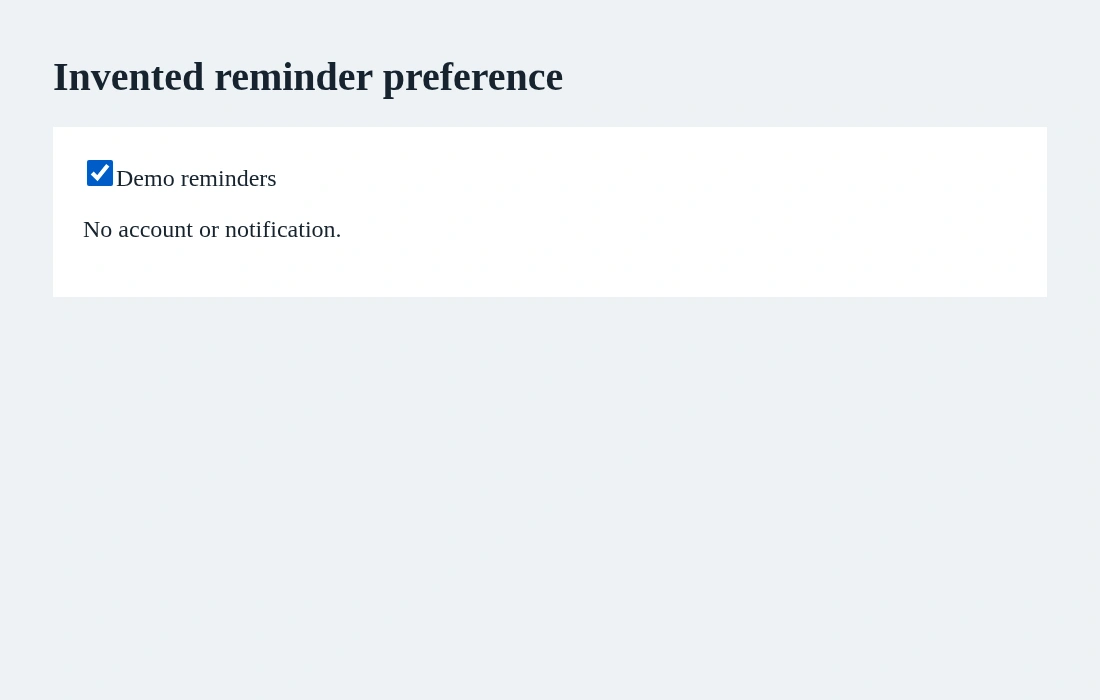
Our local specimen contains an invented checkbox called Demo reminders. It starts checked in one case and unchecked in another. Both cases request the same final state and verify it with a retrying assertion. No real notification, permission or account setting changes.
const reminders = page.getByRole('checkbox', { name: 'Demo reminders' });
await reminders.setChecked(true);
await expect(reminders).toBeChecked();
The snippet requires the Playwright test runner and imported expect. It proves the controlled element's checked state. It does not prove persistence, message delivery or a server-side preference. Add those checks through the product's supported evidence path when they belong to the journey.
In the local test, a change counter stays at zero when the checkbox starts checked and setChecked(true) is called again. From an unchecked start it becomes checked and emits one change. Repeating the desired-state call leaves that counter unchanged. A separate ordinary click then unchecks the control.
Keep initial-state requirements visible
A desired-state action can hide an unexpected starting state if the test never checks it. When the requirement includes a default of disabled, assert that default before enabling. When the case is specifically about toggling, establish the starting value and use the action that exercises the intended transition.
Do not describe setChecked as proof that every handler ran. Its immediate return for an already-correct state means a click is unnecessary in that case. A test that must observe a change event needs a controlled opposite starting state and an assertion on the required effect.
The method expects an appropriate checkbox or radio control. Our example uses a native checkbox. A custom switch or button needs its documented semantics and supported interaction, not an assumption that every on/off control accepts the same API. Keep accessibility and keyboard behavior checks separate where needed.
Repeating an action still needs a safety boundary
The local state-setting example is harmless and repeatable, but a real checkbox can trigger network requests, notifications or billing-related changes. Do not generalize the demonstration into permission to retry production settings. Use approved staging data and understand the effect and cleanup before acting.
A checked UI can also disagree with stored state. Reload or inspect an authorized independent read path if persistence is required. Record the initial value, requested value, interface result and any server evidence rather than marking the whole feature verified from one boolean.
AnyTest describes agents exploring applications and preparing reviewable tests. During review, ask whether a checkbox step names a final state or assumes a toggle from an unknown start. No particular AnyTest checkbox implementation is claimed. Keep the requirement and the observed transition together in the test note.
A state assertion and an event counter answer different questions. Preserve both in this specimen so a repeated no-op call cannot be reported as an additional user transition. In a product test, name the downstream effect required before treating that transition as complete.
Common questions
Does setChecked(true) always click?
No. It returns immediately if the checkbox is already checked.
Does checked state prove a saved preference?
No. Persistence and downstream effects need their own evidence.